MOTOREKAMOTOR DESIGN · TRAINING · ENGINEERING
Motoreka · EV traction motor

Design an EV traction motor you can defend.

From the vehicle brief to a finite-element check, with one running case carried through every step. A course for engineering teams, a companion book, and the tools that carry your numbers from one step to the next.

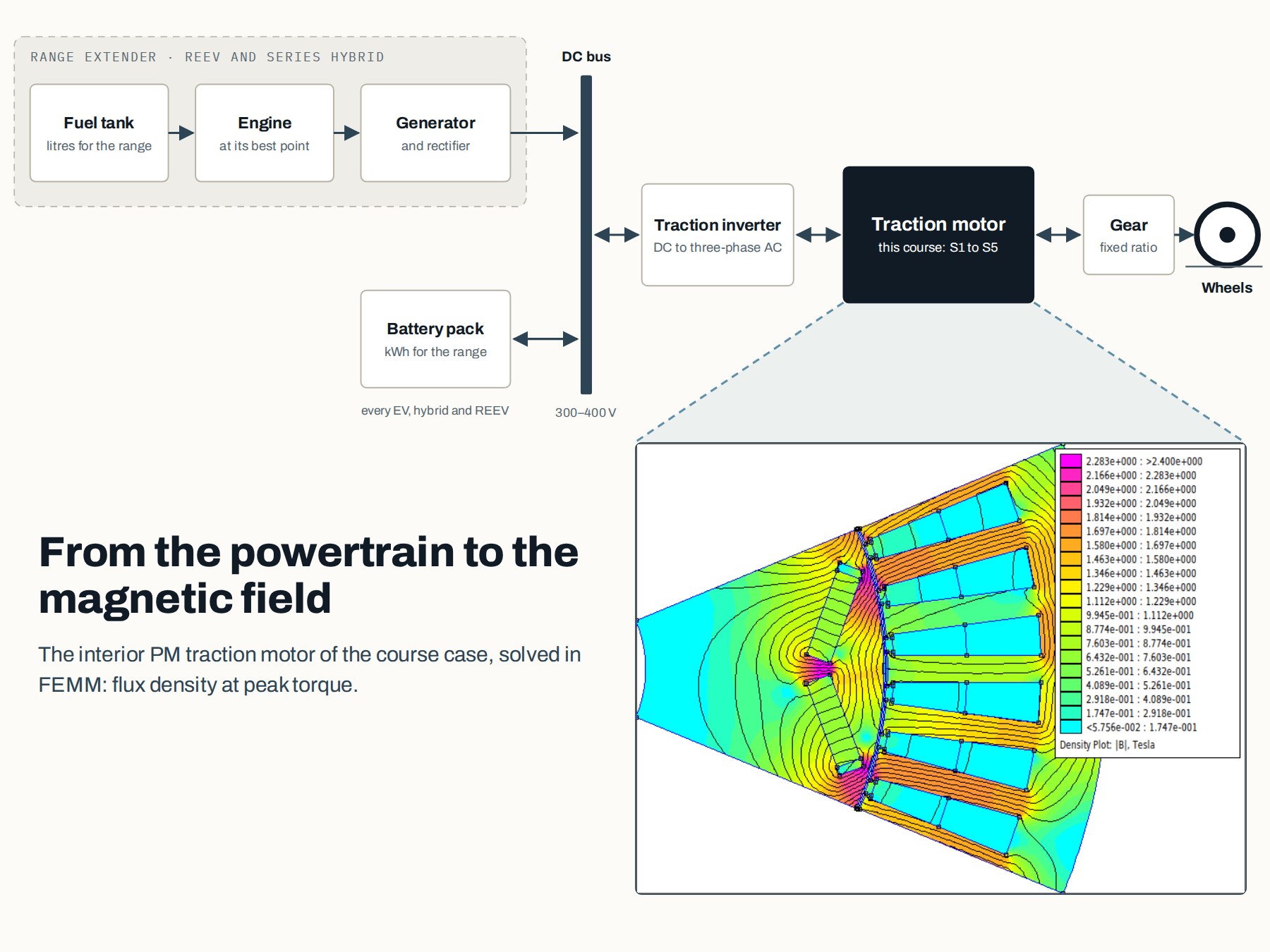
Powertrain of a range-extended EV with the traction motor highlighted, and the FEMM flux density plot of its interior PM motor at peak torque
RUNNING CASE A B-segment range-extended car, 80 kW and 191 N·m, from the brief to FEMM.
Why it matters

Range is decided in the motor

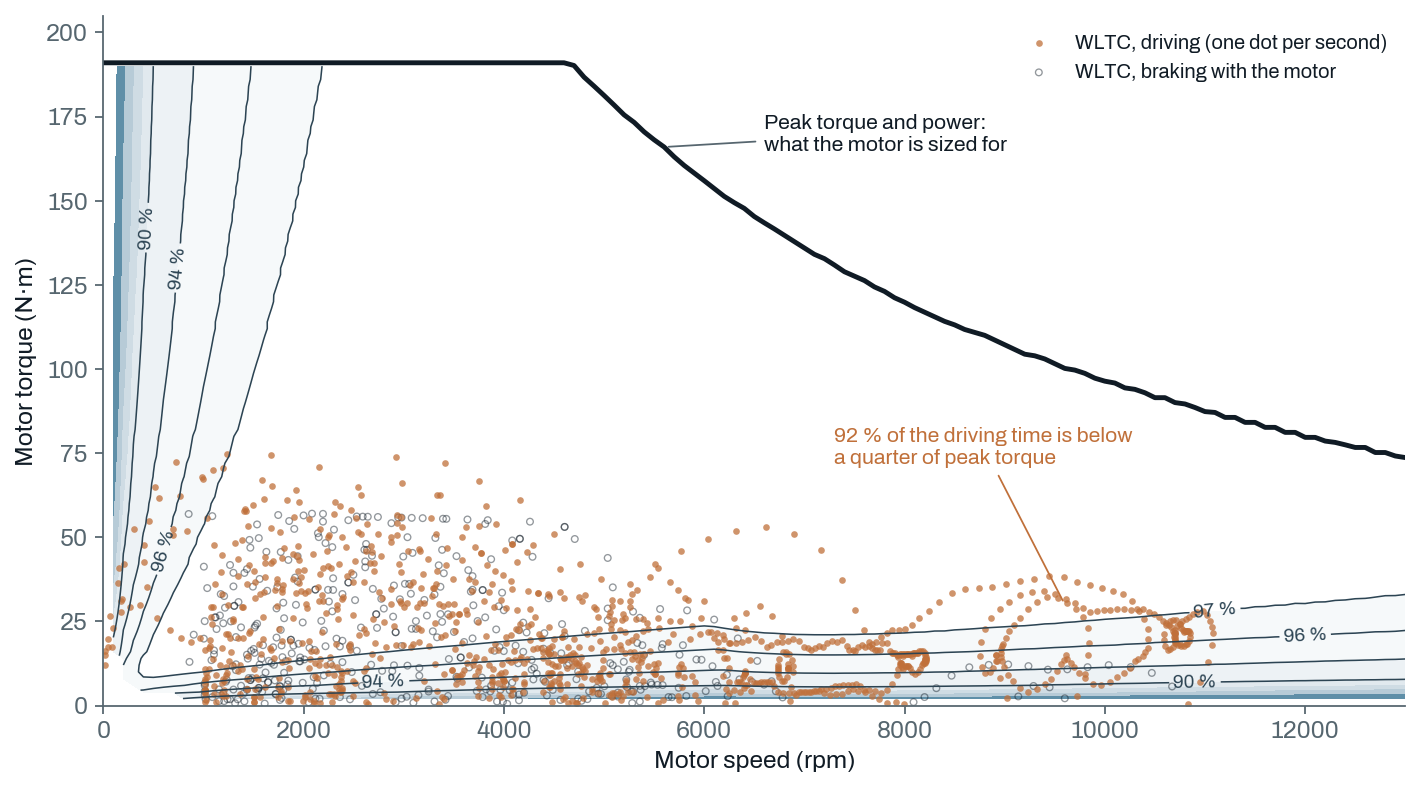
The motor is sized for peak torque, but on the test cycle it works almost entirely at light load, where its efficiency sets how much battery and fuel the car must carry.

92 %
of WLTC driving time below a quarter of peak torque
0.21 kWh
of battery saved for the same range by one point of drive efficiency
+3.1 %
energy per km from one winding detail: hairpin bars not split into strands
Choose your path

Where do you start?

For engineers

Size a motor you can defend

Go from a vehicle brief to torque, speed and main dimensions, choose the topology and materials, check what the motor asks of the inverter and cooling, and verify it in FEMM.

  • The free Sizing Calculator, now
  • The book, with worked examples and problems
  • Open runs of the course, when dates are set
For companies

One method for the whole team

For engineers who specify, source or design traction motors and must speak the motor designer's language. Groups carry one running case through every session and defend their design at the end.

  • Two mornings, in-house or at UMPSA
  • The book and all six tools for every participant
  • Your own vehicle as the case, on request
For lecturers

A complete route for your course

A textbook route through traction motor design for final-year and master's students: one worked case from the vehicle to the finite-element check, with problems at every chapter.

  • The book, with problems and answers
  • Browser tools your students can use
  • An inspection copy on request
Learn · Practice · Master

Three ways in, one method

Each step stands on its own, and each leads to the next. The book and the tools share the course’s running case and design card.

01Learn · The book

Designing an EV Traction Motor

About 290 pages in six parts: the method, worked examples, problems with answers, the design card and public benchmark data.

Free preview
02Practice · The tools
The Sizing Calculator: target checks and the design card

Six tools, one design card

Size, compare, choose, check and review: five tools in the browser and the FEMM Torque Lab for Windows, each saving the same design card.

Sizing Calculator free now
03Master · The training
  1. S0Why this course
  2. S1Sizing from vehicle specification
  3. S2Motor topologies compared
  4. S3Components and materials
  5. S4System implications
  6. S5FEMM torque lab
  7. DRDesign review

Two mornings with your team

Groups size, choose and check their own motor with the tools, build it in FEMM, and defend it in a design review. Every participant gets the book and all six tools.

Book and tools included
Practice · The tools

Six tools, one design card

Each tool opens the design card saved by the one before, so your numbers carry from the vehicle to the finite-element check. The Sizing Calculator is free to use now. The other five come with the course and with the book. Click a screenshot to enlarge it.

Stage 2 · Rating

Sizing Calculator

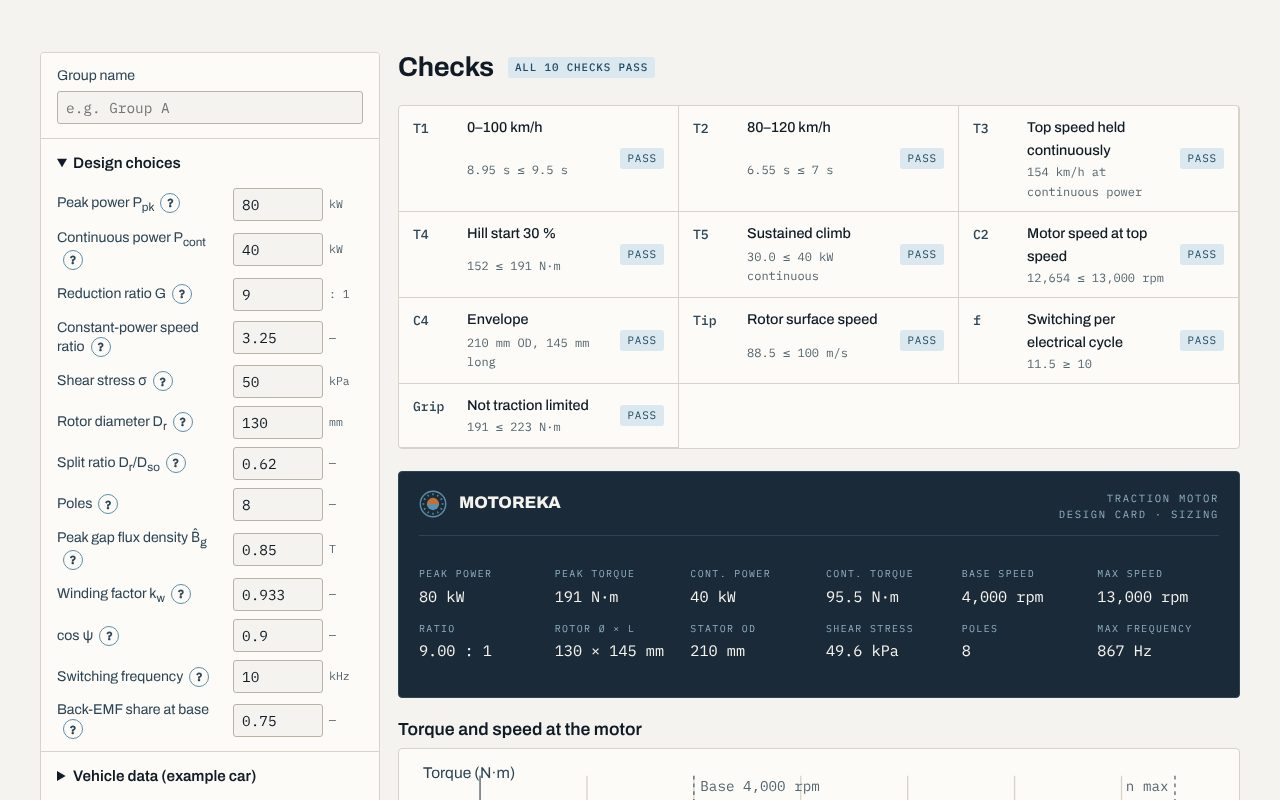
From the vehicle data and your choices to torque, speed and main dimensions, with every target checked as you type.

Free nowOpen it free
Stage 5 · Choices

Topology Comparator

Screens eight motor topologies against your rating, with weights and scores you can edit, and shows whether the winner survives other weightings.

With the course and the book
Stage 5 · Choices

Materials Explorer

Picks the electrical steel, magnet grade and winding, shows the losses and temperature margins, and estimates the material cost.

With the course and the book
Stages 3–4 · Limits and targets

System Impact Calculator

What the motor asks of the inverter and the cooling: current, fault behaviour, losses, hot spots, noise and rotor stress.

With the course and the book
Stage 6 · FEMM check

FEMM Torque Lab

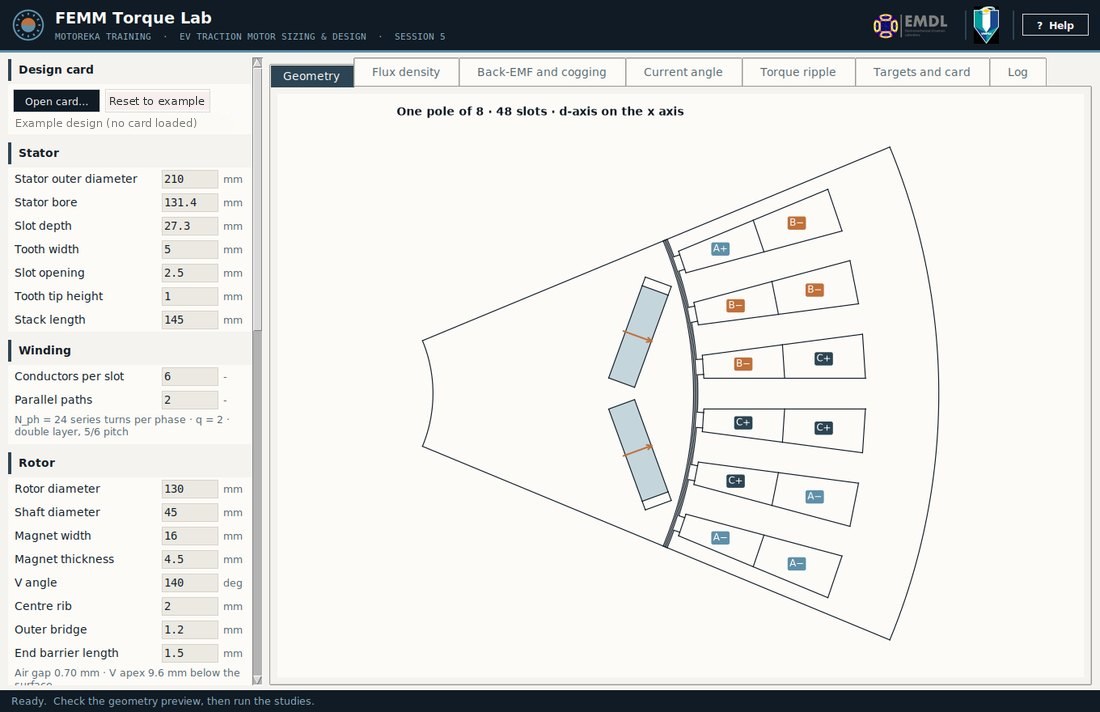
A Windows app that builds one pole of your motor in FEMM and reads its flux linkage, torque, voltage limit and ripple.

With the course and the book
Stage 7 · Review

Design Card Viewer

Opens up to four design cards side by side against the targets and a reference design, for the design review.

With the course and the book
The method

Seven stages, from the brief to the review

The course, the book and the tools follow the same order, so a number found in one carries straight into the next.

  1. 01BriefSix performance targets and the constraints of the vehicle.
  2. 02RatingPeak and continuous torque and power, base and maximum speed, the reduction ratio.
  3. 03LimitsTorque sets rotor volume, speed sets poles and frequency, the bus sets the flux budget, heat sets the current.
  4. 04TargetsMagnet flux linkage, inductances, turns per phase and current, scaled onto the bus.
  5. 05ChoicesTopology, magnet and steel, and the winding, with their losses and cost.
  6. 06FEMM checkA one-pole finite-element model: flux linkage, torque, voltage limit and ripple.
  7. 07ReviewEvery number on the design card defended against the limit it answers to.
Efficiency map of the course motor with WLTC operating points clustered at low torque
BRIEF Where the car really drives: the efficiency map with the WLTC on it
The Sizing Calculator web tool
RATING Every vehicle target checked as the design changes
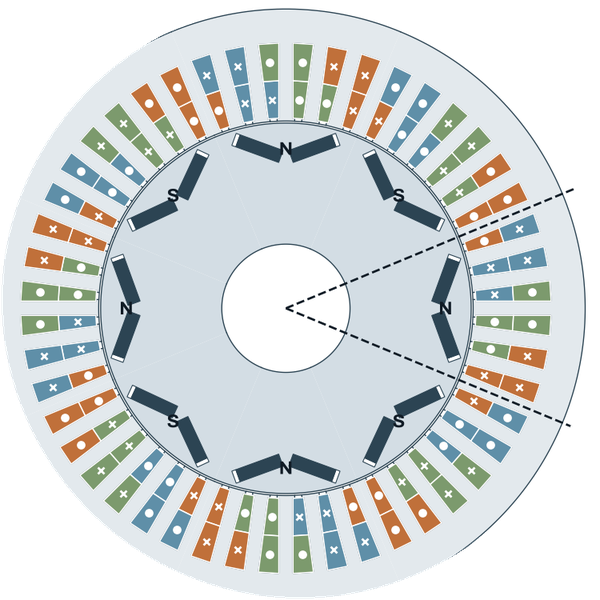
The FEMM Torque Lab desktop app showing one pole of the interior PM motor
FEMM CHECK The motor built and solved in FEMM
Learn · The book

The book, and how to get it

Designing an EV Traction Motor: From Vehicle Brief to Finite-Element Validation is the course written out as a design reference. It follows one running case through six parts, and every number in it carries its status label.

  1. IThe brief and the ratingCh. 1–3
  2. IISizing the motorCh. 4–5
  3. IIITopology, materials and costCh. 6–11
  4. IVThe motor in the vehicleCh. 12–14
  5. VFinite-element validationCh. 15–17
  6. VIThe design reviewCh. 18
ForEditionStatus
EveryonePreview34 pages: the contents, the preface, the running case and data labels, Chapter 3 in full and the blank design card.Free download
LecturersInspection copyThe full book to judge it for a course: view-only, with your name on every page, for a limited time.On request
Course participantsTrainee editionThe full book inside the course site, with the participant's name on every page.With the course
Individual readersReader editionThe full book in your own account, with your name on every page, and the companion tools.In preparation
Who is behind it

Built by a motor designer

Dr. Mohd Azri Hizami Rasid

Dr. Mohd Azri Hizami Rasid

Senior Lecturer, Faculty of Manufacturing and Mechatronic Engineering Technology, UMPSA · Head of EMDLab

His research is the design of electric machines for vehicles: synchronous reluctance and PM-assisted synchronous reluctance motors, and hairpin-wound traction motors. The course and the book pass on the method he uses in that work, with the finite-element models built in the open-source FEMM.

Publications
16, of which 10 journal articles
Recognition
CITREX 2026 Gold Award, Motoreka trainer
Lab
EMDLab, UMPSA
Research and consulting
Questions

Before you ask

What does the course include?

Two mornings of sessions and a design review, the slides and worksheets, all six tools for every participant, and the book in its trainee edition, with the participant's name on every page.

What software do I need?

A web browser for the tools. The FEMM Torque Lab runs on Windows with FEMM 4.2, which is free. Nothing else is needed.

How long is the course, and where is it run?

Two mornings: five sessions and a design review. We run it at your site for your team, or at EMDLab, UMPSA.

Who is it for?

Automotive and motor engineers who specify, source, test or design traction motors, with a degree in electrical or mechanical engineering. No prior motor design experience is assumed.

Can we use our own vehicle as the case?

Yes, ask us. The method is the same; the inputs change. The standard course uses a B-segment range-extended car.

When can I buy the book?

It is in preparation. Download the free preview now, and leave your email with “The book” to be told when the book is out.

Are the numbers in the course real?

Every number carries a label: Confirmed, Inferred, Training target or Not available. Public benchmark motors carry their sources.

Enquire

Tell us what you need

A quote for your team, a place on an open run, the book, an inspection copy, or a question. We reply within one working day.

WhatsApp+60 13-390 2485Fastest for quick questionsEmailmahizami@umpsa.edu.myFor proposals and quotations
We use your details only to answer you and, if you tick the box, to keep you informed.